


Smith Toe Raise
What is the Smith Toe Raise?
The Smith Toe Raise is an isolation exercise that targets the calves, with help from the ankles and shins, done using a Smith machine.
The smith toe raise is a calf exercise performed on a Smith machine, focusing on raising the heels to strengthen the calves. It uses a raised platform to increase the range of motion and is performed with the barbell resting on the shoulders.
How to do the Smith Toe Raise
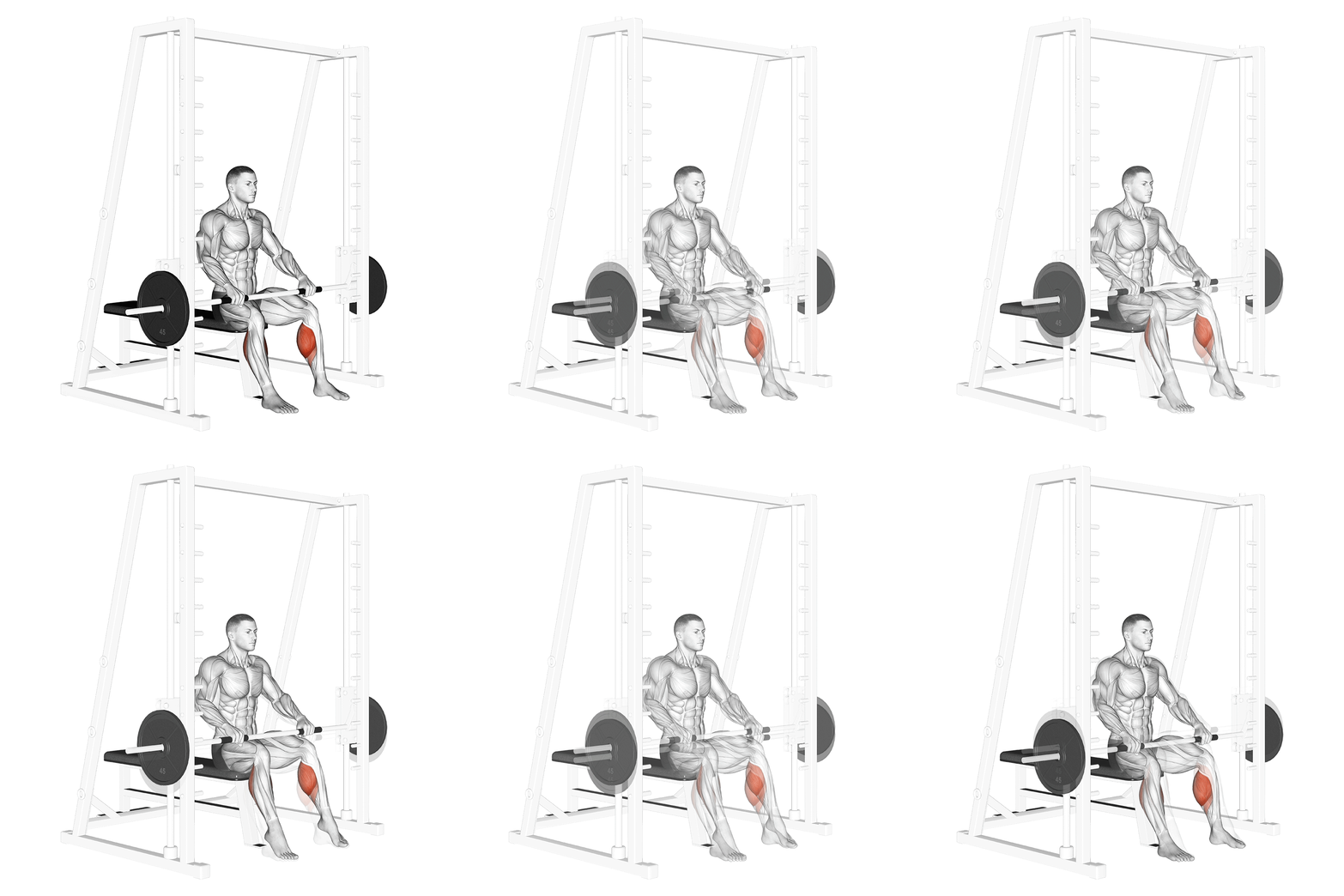
- 1
Adjust the smith machine bar to a height that allows you to comfortably stand with your feet flat on the ground.
- 2
Position yourself under the bar with your shoulders directly below it and your feet shoulder-width apart.
- 3
Place the balls of your feet on a raised platform or weight plates, with your heels hanging off the edge.
- 4
Grasp the bar with an overhand grip, slightly wider than shoulder-width apart.
- 5
Engage your core and keep your back straight throughout the exercise.
- 6
Slowly raise your heels as high as possible, lifting your body weight onto the balls of your feet.
- 7
Pause for a moment at the top, then slowly lower your heels back down to the starting position.
- 8
Repeat for the desired number of repetitions.
Smith Toe Raise Muscles Worked
The primary muscle group worked during the Smith Toe Raise is the calves. Secondary muscles including the ankles and shins assist throughout the movement, contributing to stability and force production.
- Primary muscle
- Calves
- Secondary muscles
- Ankles, Shins
- Body part
- Lower Legs
- Movement type
- Isolation
- Equipment needed
- A Smith machine.
Sets and reps for the Smith Toe Raise
The Smith Toe Raise is an isolation exercise: it trains the calves on their own, so moderate weights and controlled reps work better than very heavy sets. Do it after your compound lifts.
| Goal | Sets | Reps | Rest |
|---|---|---|---|
| Strength | 3 to 4 | 6 to 10 | 90 sec to 2 min |
| Muscle growth | 3 to 4 | 10 to 15 | 60 to 90 sec |
| Endurance | 2 to 3 | 15 to 25 | 30 to 60 sec |
- Progress with double progression: once you reach the top of the rep range on every set with clean form, add 2.5 to 5 kg (5 to 10 lb) and work back up.
- For muscle growth, about 10 to 20 hard sets per muscle per week works for most people, counting every exercise that trains the calves.
- New to the Smith Toe Raise? Spend the first 2 to 3 weeks in the muscle growth range with a load you could lift 2 or 3 more times, then try heavier sets.
Smith Toe Raise Alternatives
These exercises also train the calves, each with different equipment, so you can swap one in when your gym is busy, you train at home or you want a change.
- Barbell Standing Calf RaiseBarbellNo Smith machine? A barbell lets you load the most weight and add it in small steps, which suits strength work.
- Dumbbell Standing Calf RaiseDumbbellNo Smith machine? Dumbbells train each side on its own, which helps even out strength differences.
- Lever Standing Calf RaiseLeverage MachineNo Smith machine? The machine guides the path, so you can push hard safely without a spotter.
- Cable Standing Calf RaiseCableNo Smith machine? The cable keeps tension on the calves through the whole range of motion.
- Donkey Calf RaiseBody WeightNo Smith machine? This version needs no equipment, so you can do it at home or while traveling.
- Band Single Leg Calf RaiseBandNo Smith machine? A band is light and portable, good for home workouts, travel or warm-up sets.
Exercises That Pair Well With the Smith Toe Raise
For a short lower body workout, start with the heavier compound lift below, then do 2 to 3 sets of the others and finish with the Smith Toe Raise.
More Calves Exercises
- Standing Calf Raise (On A Staircase) · Body Weight
- Standing Calves · Body Weight
- Standing Calves Calf Stretch · Body Weight
- Weighted Donkey Calf Raise · Weighted
- Ankle Circles · Body Weight
- Assisted Lying Calves Stretch · Assisted
Track the Smith Toe Raise in YourFit
- Log sets, reps and weight in a few taps, with your previous sets for the Smith Toe Raise shown next to each one.
- New personal records are flagged automatically, so you know when you beat your best.
- See your strength level, plus how many weekly sets each muscle gets, including the calves.