


Standing Calf Raise (On A Staircase)
What is the Standing Calf Raise (On A Staircase)?
The Standing Calf Raise (On A Staircase) is an isolation exercise that targets the calves, with help from the ankles and feet, done using only your body weight.
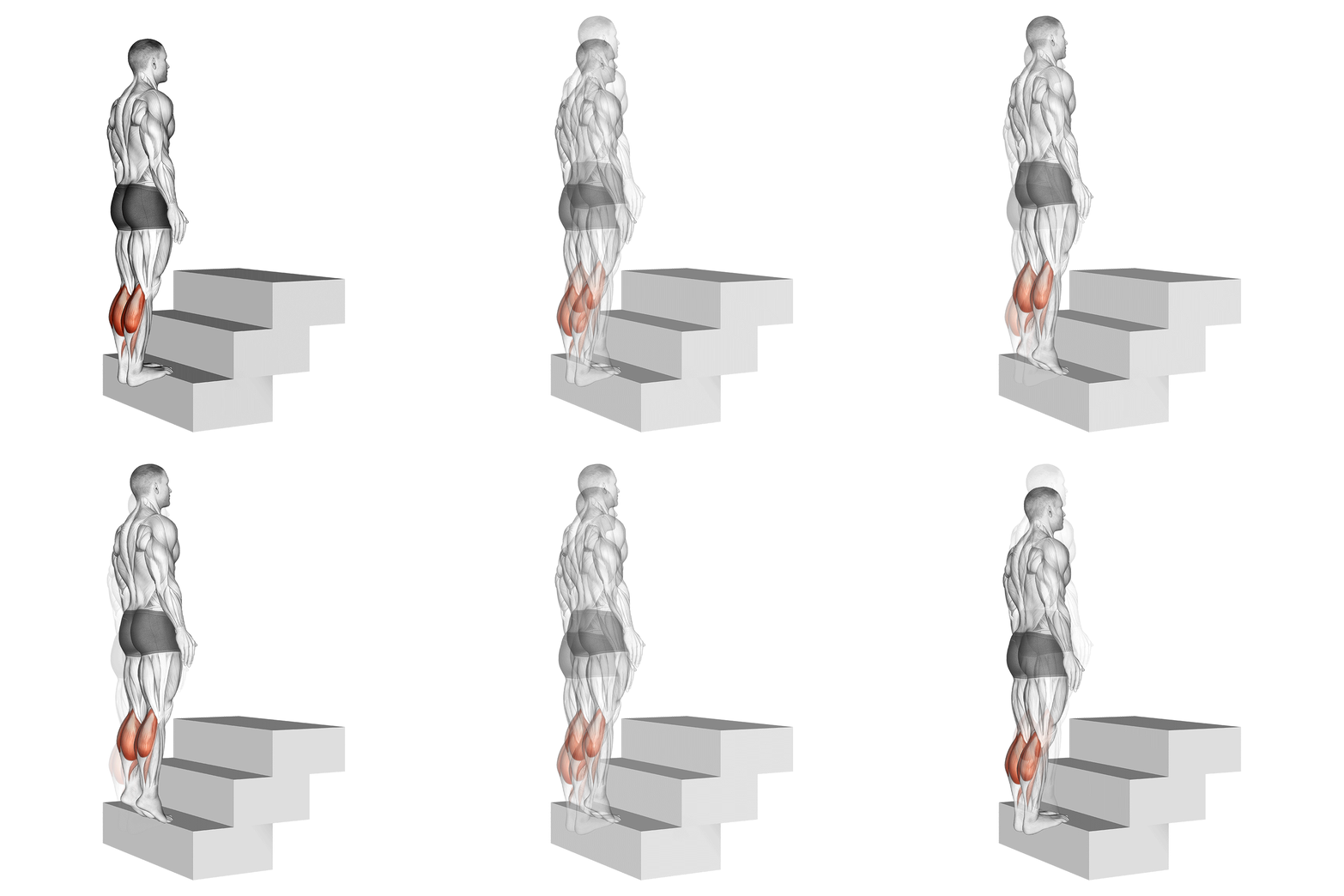
The standing calf raise (on a staircase) is a bodyweight exercise that targets the calves by raising and lowering the heels while standing on the edge of a step. It also engages the ankles and feet for stabilization.
How to do the Standing Calf Raise (On A Staircase)
- 1
Stand on the edge of a step or a sturdy platform with your heels hanging off and your toes on the step.
- 2
Hold onto a railing or wall for balance if needed.
- 3
Slowly raise your heels as high as possible, lifting your body weight onto the balls of your feet.
- 4
Pause for a moment at the top, then slowly lower your heels back down to the starting position.
- 5
Repeat for the desired number of repetitions.
Standing Calf Raise (On A Staircase) Muscles Worked
The primary muscle group worked during the Standing Calf Raise (On A Staircase) is the calves. Secondary muscles including the ankles and feet assist throughout the movement, contributing to stability and force production.
- Primary muscle
- Calves
- Secondary muscles
- Ankles, Feet
- Body part
- Lower Legs
- Movement type
- Isolation
- Equipment needed
- No equipment needed: just your body weight.
Sets and reps for the Standing Calf Raise (On A Staircase)
The Standing Calf Raise (On A Staircase) is an isolation exercise: it trains the calves on their own, so moderate weights and controlled reps work better than very heavy sets. Do it after your compound lifts.
| Goal | Sets | Reps | Rest |
|---|---|---|---|
| Strength | 3 to 4 | 8 to 12 (use a harder version) | 90 sec |
| Muscle growth | 3 | 12 to 20 | 60 sec |
| Endurance | 2 to 3 | 20+ | 30 to 45 sec |
- To progress, add reps first, then slow the lowering phase to about 3 seconds, pause at the hardest point, or move to a harder variation.
- For muscle growth, about 10 to 20 hard sets per muscle per week works for most people, counting every exercise that trains the calves.
- New to the Standing Calf Raise (On A Staircase)? Start with 2 to 3 sets, ending each set 2 or 3 reps before your form breaks down, and add a rep or two each week.
Standing Calf Raise (On A Staircase) Alternatives
These exercises also train the calves, each with different equipment, so you can swap one in when your gym is busy, you train at home or you want a change.
- Dumbbell Standing Calf RaiseDumbbellWant more resistance? Dumbbells train each side on its own, which helps even out strength differences.
- Band Single Leg Calf RaiseBandA band is light and portable, good for home workouts, travel or warm-up sets.
- Weighted Donkey Calf RaiseWeightedWant more resistance? Adding a plate, vest or belt keeps it challenging once bodyweight reps get easy.
- Cable Standing Calf RaiseCableWant more resistance? The cable keeps tension on the calves through the whole range of motion.
- Lever Standing Calf RaiseLeverage MachineWant more resistance? The machine guides the path, so you can push hard safely without a spotter.
- Barbell Standing Calf RaiseBarbellWant more resistance? A barbell lets you load the most weight and add it in small steps, which suits strength work.
Exercises That Pair Well With the Standing Calf Raise (On A Staircase)
For a short lower body workout, start with the heavier compound lift below, then do 2 to 3 sets of the others and finish with the Standing Calf Raise (On A Staircase).
More Calves Exercises
- Standing Calves · Body Weight
- Standing Calves Calf Stretch · Body Weight
- Ankle Circles · Body Weight
- Assisted Lying Calves Stretch · Assisted
- Band Single Leg Reverse Calf Raise · Band
- Barbell Floor Calf Raise · Barbell
Track the Standing Calf Raise (On A Staircase) in YourFit
- Log sets, reps and weight in a few taps, with your previous sets for the Standing Calf Raise (On A Staircase) shown next to each one.
- New personal records are flagged automatically, so you know when you beat your best.
- See your strength level, plus how many weekly sets each muscle gets, including the calves.