


Barbell Reverse Grip Bent Over Row
What is the Barbell Reverse Grip Bent Over Row?
The Barbell Reverse Grip Bent Over Row is a compound strength exercise that targets the upper back, with help from the biceps and forearms, done using a barbell.
The barbell reverse grip bent over row is a compound exercise targeting the upper back, with secondary emphasis on the biceps and forearms. It involves pulling a barbell towards the lower chest while bent over, requiring good form and core stability.
How to do the Barbell Reverse Grip Bent Over Row
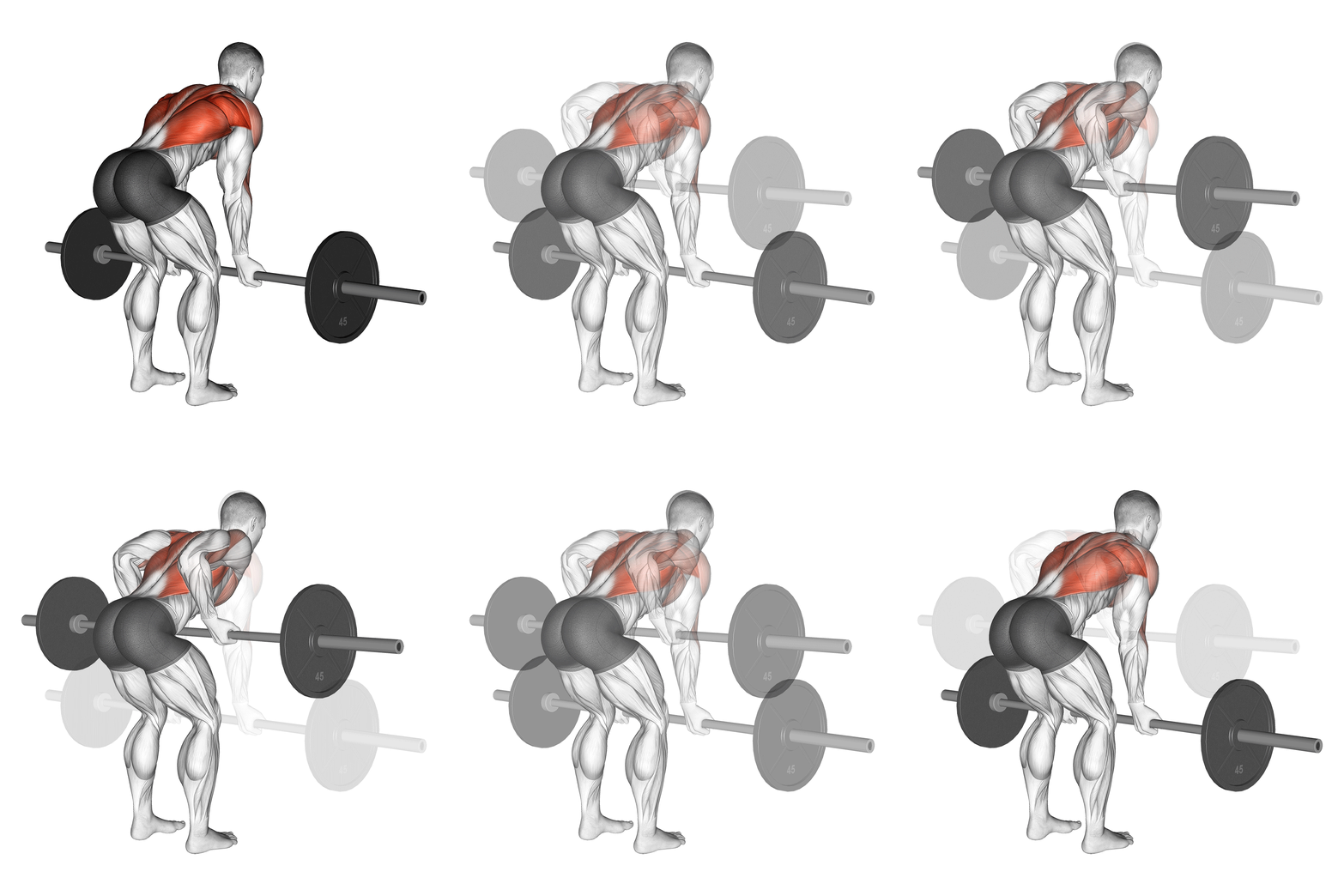
- 1
Stand with your feet shoulder-width apart and knees slightly bent.
- 2
Hold a barbell with an overhand grip, palms facing down, and hands slightly wider than shoulder-width apart.
- 3
Bend forward at the hips, keeping your back straight and chest up, until your torso is almost parallel to the floor.
- 4
Pull the barbell towards your lower chest, squeezing your shoulder blades together.
- 5
Pause for a moment at the top, then slowly lower the barbell back to the starting position.
- 6
Repeat for the desired number of repetitions.
Barbell Reverse Grip Bent Over Row Muscles Worked
The primary muscle group worked during the Barbell Reverse Grip Bent Over Row is the upper back. Secondary muscles including the biceps and forearms assist throughout the movement, contributing to stability and force production.
- Primary muscle
- Upper Back
- Secondary muscles
- Biceps, Forearms
- Body part
- Back
- Movement type
- Compound
- Equipment needed
- A barbell.
Sets and reps for the Barbell Reverse Grip Bent Over Row
The Barbell Reverse Grip Bent Over Row is a compound lift: several joints and muscles work together, so it suits both heavy strength work and moderate rep ranges. Put it early in your workout while you are fresh.
| Goal | Sets | Reps | Rest |
|---|---|---|---|
| Strength | 3 to 5 | 3 to 6 | 2 to 3 min |
| Muscle growth | 3 to 4 | 6 to 12 | 90 sec to 2 min |
| Endurance | 2 to 3 | 12 to 20 | 30 to 60 sec |
- Progress with double progression: once you reach the top of the rep range on every set with clean form, add 2.5 to 5 kg (5 to 10 lb) and work back up.
- For muscle growth, about 10 to 20 hard sets per muscle per week works for most people, counting every exercise that trains the upper back.
Barbell Reverse Grip Bent Over Row Alternatives
These exercises also train the upper back, each with different equipment, so you can swap one in when your gym is busy, you train at home or you want a change.
- Dumbbell One Arm Bent-Over RowDumbbellNo barbell? Dumbbells train each side on its own, which helps even out strength differences.
- Smith Reverse Grip Bent Over RowSmith MachineNo barbell? The fixed bar path lets you train heavy without a spotter.
- Lever T-Bar Reverse Grip RowLeverage MachineNo barbell? The machine guides the path, so you can push hard safely without a spotter.
- Cable Seated RowCableNo barbell? The cable keeps tension on the upper back through the whole range of motion.
- Inverted RowBody WeightNo barbell? This version needs no equipment, so you can do it at home or while traveling.
- Kettlebell Alternating RowKettlebellNo barbell? The kettlebell's offset weight adds a grip and stability challenge.
Exercises That Pair Well With the Barbell Reverse Grip Bent Over Row
For a short pull workout, do the Barbell Reverse Grip Bent Over Row first while you are fresh, then 2 to 3 sets of each of these.
More Upper Back Exercises
- Barbell Reverse Grip Incline Bench Row · Barbell
- Bodyweight Squatting Row · Body Weight
- Bodyweight Standing Close-Grip One Arm Row · Body Weight
- Bodyweight Standing Close-Grip Row · Body Weight
- Bodyweight Standing One Arm Row · Body Weight
- Bodyweight Standing Row · Body Weight
Track the Barbell Reverse Grip Bent Over Row in YourFit
- Log sets, reps and weight in a few taps, with your previous sets for the Barbell Reverse Grip Bent Over Row shown next to each one.
- New personal records are flagged automatically, so you know when you beat your best.
- See your strength level, plus how many weekly sets each muscle gets, including the upper back.