


Bodyweight Standing Calf Raise
What is the Bodyweight Standing Calf Raise?
The Bodyweight Standing Calf Raise is an isolation exercise that targets the calves, with help from the ankles and feet, done using only your body weight.
The bodyweight standing calf raise is a simple exercise that targets the calf muscles. It involves lifting your heels off the ground while standing, using only your body weight for resistance. This movement helps to strengthen and tone the calves, and can also improve ankle stability.
How to do the Bodyweight Standing Calf Raise
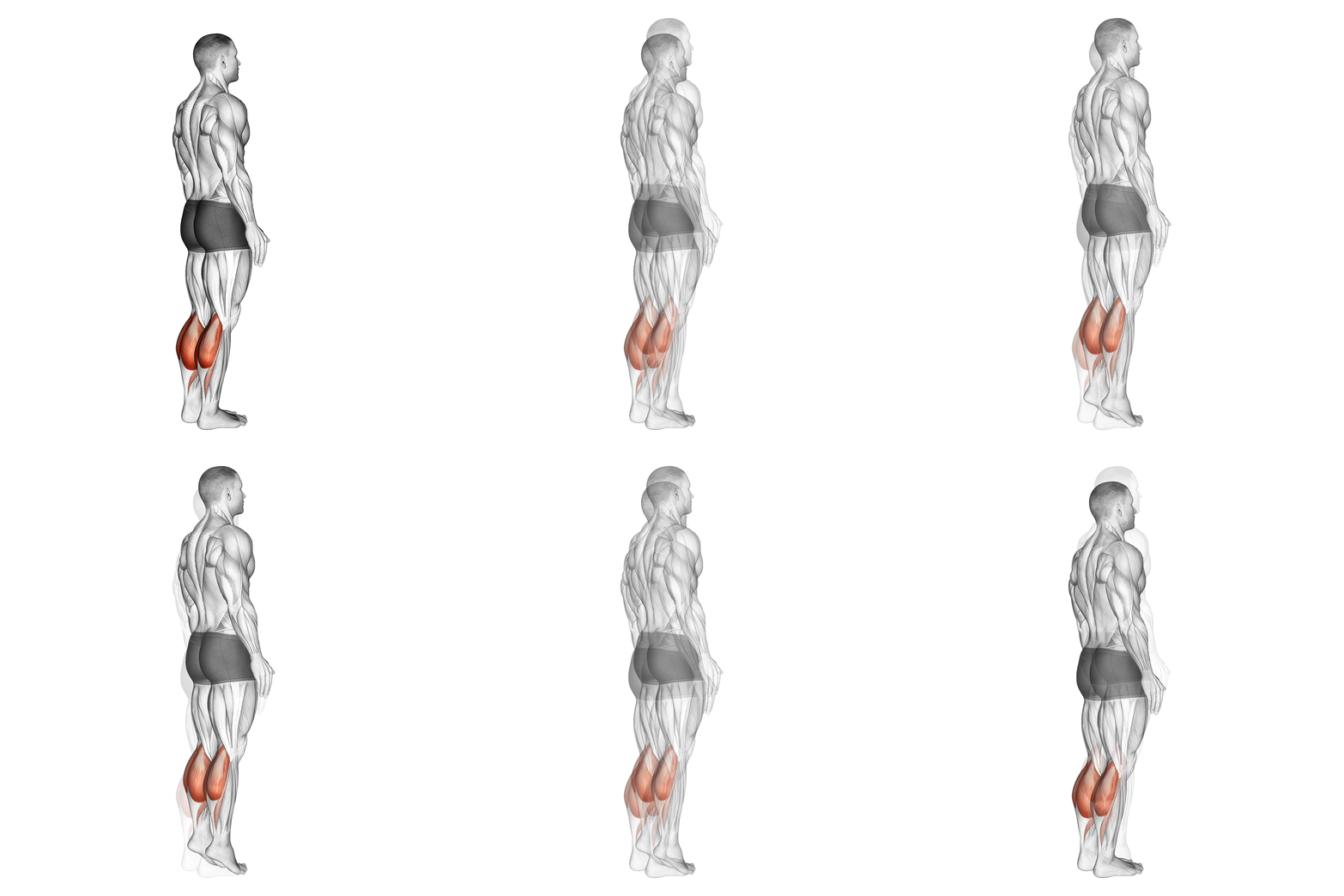
- 1
Stand with your feet shoulder-width apart, toes pointing forward.
- 2
Place your hands on a wall or stable surface for balance.
- 3
Slowly raise your heels off the ground, lifting your body weight onto the balls of your feet.
- 4
Pause for a moment at the top, then slowly lower your heels back down to the starting position.
- 5
Repeat for the desired number of repetitions.
Bodyweight Standing Calf Raise Muscles Worked
The primary muscle group worked during the Bodyweight Standing Calf Raise is the calves. Secondary muscles including the ankles and feet assist throughout the movement, contributing to stability and force production.
- Primary muscle
- Calves
- Secondary muscles
- Ankles, Feet
- Body part
- Lower Legs
- Movement type
- Isolation
- Equipment needed
- No equipment needed: just your body weight.
Sets and reps for the Bodyweight Standing Calf Raise
The Bodyweight Standing Calf Raise is an isolation exercise: it trains the calves on their own, so moderate weights and controlled reps work better than very heavy sets. Do it after your compound lifts.
| Goal | Sets | Reps | Rest |
|---|---|---|---|
| Strength | 3 to 4 | 8 to 12 (use a harder version) | 90 sec |
| Muscle growth | 3 | 12 to 20 | 60 sec |
| Endurance | 2 to 3 | 20+ | 30 to 45 sec |
- To progress, add reps first, then slow the lowering phase to about 3 seconds, pause at the hardest point, or move to a harder variation.
- For muscle growth, about 10 to 20 hard sets per muscle per week works for most people, counting every exercise that trains the calves.
- New to the Bodyweight Standing Calf Raise? Start with 2 to 3 sets, ending each set 2 or 3 reps before your form breaks down, and add a rep or two each week.
Bodyweight Standing Calf Raise Alternatives
These exercises also train the calves, each with different equipment, so you can swap one in when your gym is busy, you train at home or you want a change.
- Dumbbell Standing Calf RaiseDumbbellWant more resistance? Dumbbells train each side on its own, which helps even out strength differences.
- Band Single Leg Calf RaiseBandA band is light and portable, good for home workouts, travel or warm-up sets.
- Weighted Donkey Calf RaiseWeightedWant more resistance? Adding a plate, vest or belt keeps it challenging once bodyweight reps get easy.
- Cable Standing Calf RaiseCableWant more resistance? The cable keeps tension on the calves through the whole range of motion.
- Lever Standing Calf RaiseLeverage MachineWant more resistance? The machine guides the path, so you can push hard safely without a spotter.
- Barbell Standing Calf RaiseBarbellWant more resistance? A barbell lets you load the most weight and add it in small steps, which suits strength work.
Exercises That Pair Well With the Bodyweight Standing Calf Raise
For a short lower body workout, start with the heavier compound lift below, then do 2 to 3 sets of the others and finish with the Bodyweight Standing Calf Raise.
More Calves Exercises
- Box Jump Down With One Leg Stabilization · Body Weight
- Cable Standing One Leg Calf Raise · Cable
- Calf Push Stretch With Hands Against Wall · Body Weight
- Calf Stretch With Hands Against Wall · Body Weight
- Calf Stretch With Rope · Rope
- Circles Knee Stretch · Body Weight
Track the Bodyweight Standing Calf Raise in YourFit
- Log sets, reps and weight in a few taps, with your previous sets for the Bodyweight Standing Calf Raise shown next to each one.
- New personal records are flagged automatically, so you know when you beat your best.
- See your strength level, plus how many weekly sets each muscle gets, including the calves.