


Exercise Ball Back Extension With Hands Behind Head
What is the Exercise Ball Back Extension With Hands Behind Head?
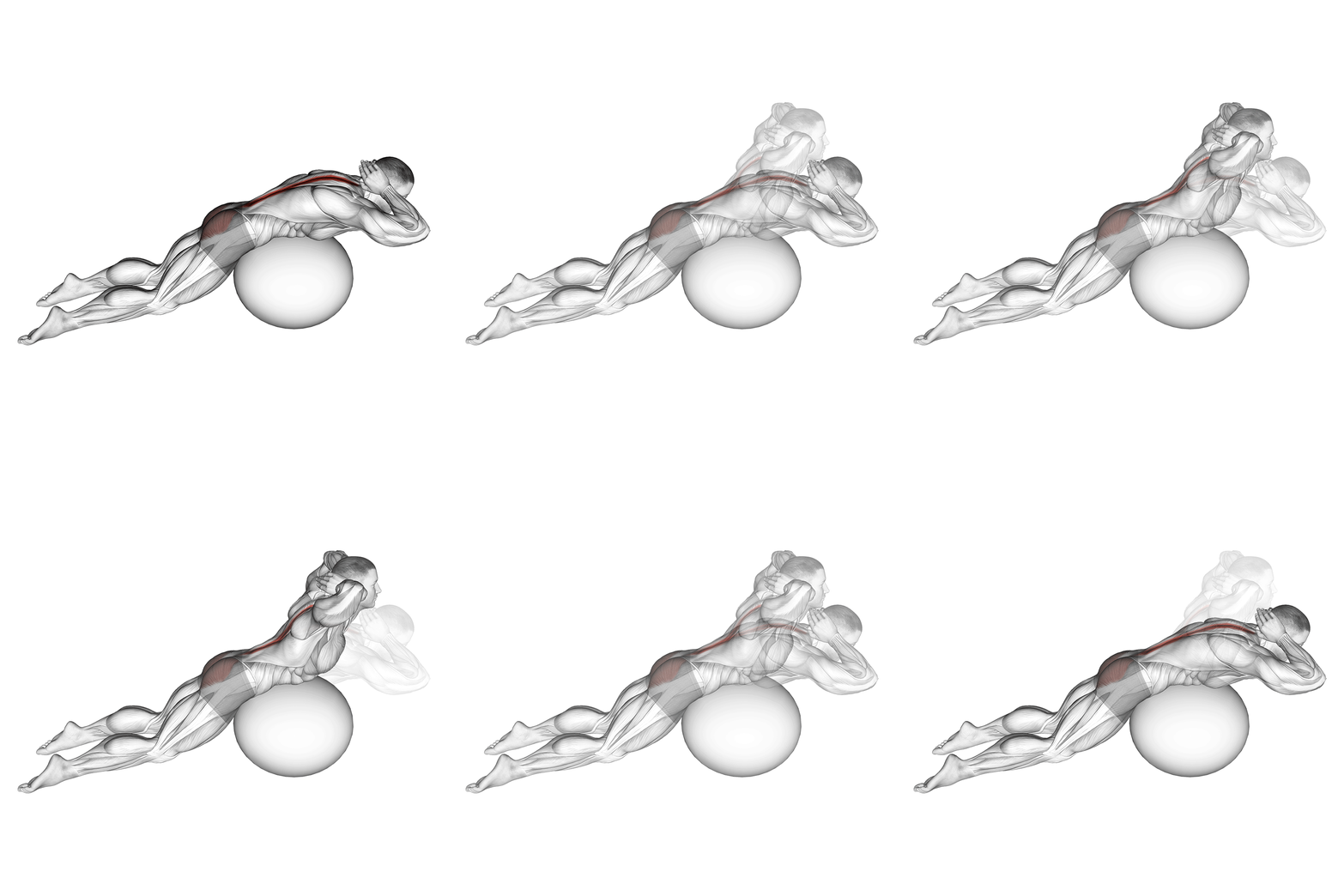
The Exercise Ball Back Extension With Hands Behind Head is an isolation exercise that targets the lower back (spinal erectors), with help from the glutes and hamstrings, done using a stability ball.
This exercise targets the spinal erectors and involves performing back extensions while lying face down on a stability ball, with hands placed behind the head for increased difficulty. It also engages the glutes and hamstrings as secondary muscles.
How to do the Exercise Ball Back Extension With Hands Behind Head
- 1
Place the stability ball on the ground and lie face down on top of it with your hips resting on the ball.
- 2
Position your feet against a wall or other stable surface for support.
- 3
Cross your arms behind your head, with your hands touching the back of your head.
- 4
Engage your core and slowly lift your upper body off the ball, extending your back until your body forms a straight line from your head to your hips.
- 5
Pause for a moment at the top of the movement, then slowly lower your upper body back down to the starting position.
- 6
Repeat for the desired number of repetitions.
Exercise Ball Back Extension With Hands Behind Head Muscles Worked
The primary muscle group worked during the Exercise Ball Back Extension With Hands Behind Head is the lower back (spinal erectors). Secondary muscles including the glutes and hamstrings assist throughout the movement, contributing to stability and force production.
- Primary muscle
- Lower Back (Spinal Erectors)
- Secondary muscles
- Glutes, Hamstrings
- Body part
- Back
- Movement type
- Isolation
- Equipment needed
- A stability ball.
Sets and reps for the Exercise Ball Back Extension With Hands Behind Head
The Exercise Ball Back Extension With Hands Behind Head is an isolation exercise: it trains the lower back on their own, so moderate weights and controlled reps work better than very heavy sets. Do it after your compound lifts.
| Goal | Sets | Reps | Rest |
|---|---|---|---|
| Strength | 3 to 4 | 6 to 10 | 90 sec to 2 min |
| Muscle growth | 3 to 4 | 10 to 15 | 60 to 90 sec |
| Endurance | 2 to 3 | 15 to 25 | 30 to 60 sec |
- Add reps first; once the top of the range feels easy on every set, add load or pick a harder variation.
- For muscle growth, about 10 to 20 hard sets per muscle per week works for most people, counting every exercise that trains the lower back.
Exercise Ball Back Extension With Hands Behind Head Alternatives
These exercises also train the lower back, each with different equipment, so you can swap one in when your gym is busy, you train at home or you want a change.
- HyperextensionBody WeightNo stability ball? This version needs no equipment, so you can do it at home or while traveling.
- Lever Back ExtensionLeverage MachineNo stability ball? The machine guides the path, so you can push hard safely without a spotter.
- Band Straight Leg DeadliftBandNo stability ball? A band is light and portable, good for home workouts, travel or warm-up sets.
- Weighted Hyperextension (On Stability Ball)WeightedNo stability ball? Adding a plate, vest or belt keeps it challenging once bodyweight reps get easy.
Exercises That Pair Well With the Exercise Ball Back Extension With Hands Behind Head
For a short core workout, pair the Exercise Ball Back Extension With Hands Behind Head with 2 to 3 sets of each of these, resting about a minute between sets.
More Lower Back Exercises
- Exercise Ball Back Extension With Rotation · Stability Ball
- Exercise Ball Hug · Stability Ball
- Exercise Ball Prone Leg Raise · Stability Ball
- Lower Back Curl · Body Weight
- Roller Back Stretch · Roller
- Sphinx · Body Weight
Track the Exercise Ball Back Extension With Hands Behind Head in YourFit
- Log sets, reps and weight in a few taps, with your previous sets for the Exercise Ball Back Extension With Hands Behind Head shown next to each one.
- New personal records are flagged automatically, so you know when you beat your best.
- See your strength level, plus how many weekly sets each muscle gets, including the lower back.