


Exercise Ball Pike Push Up
What is the Exercise Ball Pike Push Up?
The Exercise Ball Pike Push Up is a compound strength exercise that targets the chest (pectorals), with help from the shoulders, triceps and core, done using a stability ball.
The exercise ball pike push up is a challenging upper body and core exercise that combines a pike movement with a push-up, performed with the shins on a stability ball. This exercise targets the pectorals while also engaging the shoulders, triceps, and core for stabilization and strength.
How to do the Exercise Ball Pike Push Up
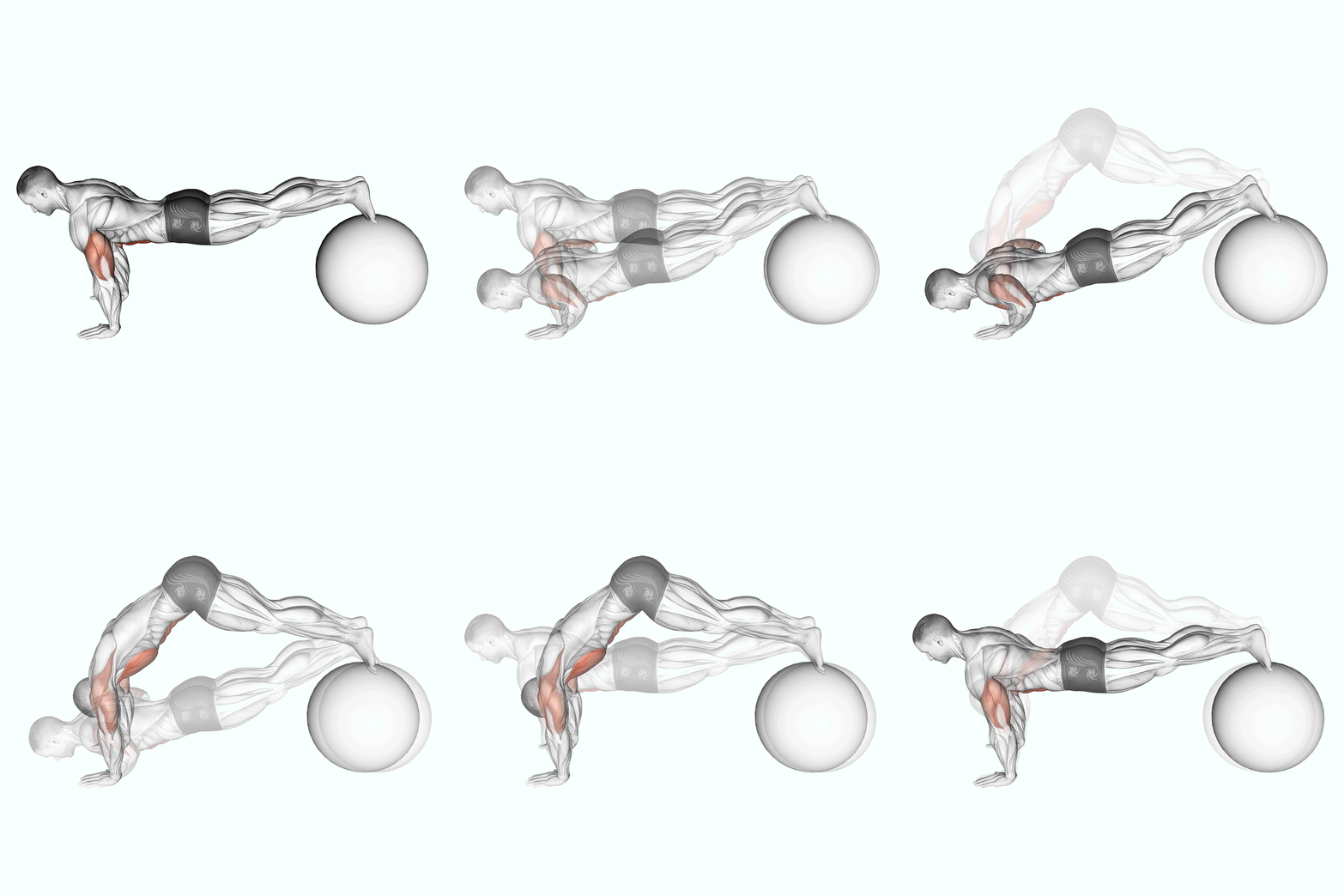
- 1
Start in a push-up position with your hands on the floor and your shins resting on the stability ball.
- 2
Engage your core and lift your hips up towards the ceiling, rolling the ball towards your hands.
- 3
Keep your legs straight and your body in a pike position, forming an inverted V shape.
- 4
Bend your elbows and lower your upper body towards the floor, keeping your head in line with your hands.
- 5
Push through your hands and extend your arms to return to the starting position.
- 6
Repeat for the desired number of repetitions.
Exercise Ball Pike Push Up Muscles Worked
The primary muscle group worked during the Exercise Ball Pike Push Up is the chest (pectorals). Secondary muscles including the shoulders, triceps and core assist throughout the movement, contributing to stability and force production.
- Primary muscle
- Chest (Pectorals)
- Secondary muscles
- Shoulders, Triceps, Core
- Body part
- Chest
- Movement type
- Compound
- Equipment needed
- A stability ball.
Sets and reps for the Exercise Ball Pike Push Up
The Exercise Ball Pike Push Up is a compound lift: several joints and muscles work together, so it suits both heavy strength work and moderate rep ranges. Put it early in your workout while you are fresh.
| Goal | Sets | Reps | Rest |
|---|---|---|---|
| Strength | 3 to 5 | 3 to 6 | 2 to 3 min |
| Muscle growth | 3 to 4 | 6 to 12 | 90 sec to 2 min |
| Endurance | 2 to 3 | 12 to 20 | 30 to 60 sec |
- Add reps first; once the top of the range feels easy on every set, add load or pick a harder variation.
- For muscle growth, about 10 to 20 hard sets per muscle per week works for most people, counting every exercise that trains the chest.
- The Exercise Ball Pike Push Up is an advanced move: stay in the higher rep ranges until your form holds steady from the first rep to the last.
Exercise Ball Pike Push Up Alternatives
These exercises also train the chest, each with different equipment, so you can swap one in when your gym is busy, you train at home or you want a change.
- Dumbbell Bench PressDumbbellNo stability ball? Dumbbells train each side on its own, which helps even out strength differences.
- Push-UpBody WeightNo stability ball? This version needs no equipment, so you can do it at home or while traveling.
- Barbell Bench PressBarbellNo stability ball? A barbell lets you load the most weight and add it in small steps, which suits strength work.
- Cable Cross-Over VariationCableNo stability ball? The cable keeps tension on the chest through the whole range of motion.
- Lever Chest PressLeverage MachineNo stability ball? The machine guides the path, so you can push hard safely without a spotter.
- Band Bench PressBandNo stability ball? A band is light and portable, good for home workouts, travel or warm-up sets.
Exercises That Pair Well With the Exercise Ball Pike Push Up
For a short push workout, do the Exercise Ball Pike Push Up first while you are fresh, then 2 to 3 sets of each of these.
More Chest Exercises
- Floor Fly (With Barbell) · Barbell
- Full Planche Push-Up · Body Weight
- Hands Bike · Upper Body Ergometer
- Hyght Dumbbell Fly · Dumbbell
- Incline Push Up Depth Jump · Body Weight
- Incline Push-Up · Body Weight
Track the Exercise Ball Pike Push Up in YourFit
- Log sets, reps and weight in a few taps, with your previous sets for the Exercise Ball Pike Push Up shown next to each one.
- New personal records are flagged automatically, so you know when you beat your best.
- See your strength level, plus how many weekly sets each muscle gets, including the chest.