

Band One Arm Single Leg Split Squat
This is a variation of the Band Single Leg Split Squat. See that page for the standard version, alternatives and programming.
What is the Band One Arm Single Leg Split Squat?
The Band One Arm Single Leg Split Squat is a compound strength exercise that targets the quads, with help from the glutes and hamstrings, done using a resistance band.
The band one arm single leg split squat is a lower body exercise that targets the quadriceps, with secondary emphasis on the glutes and hamstrings. It involves performing a split squat on one leg with the rear foot elevated and a resistance band around the ankles, challenging balance and unilateral strength.
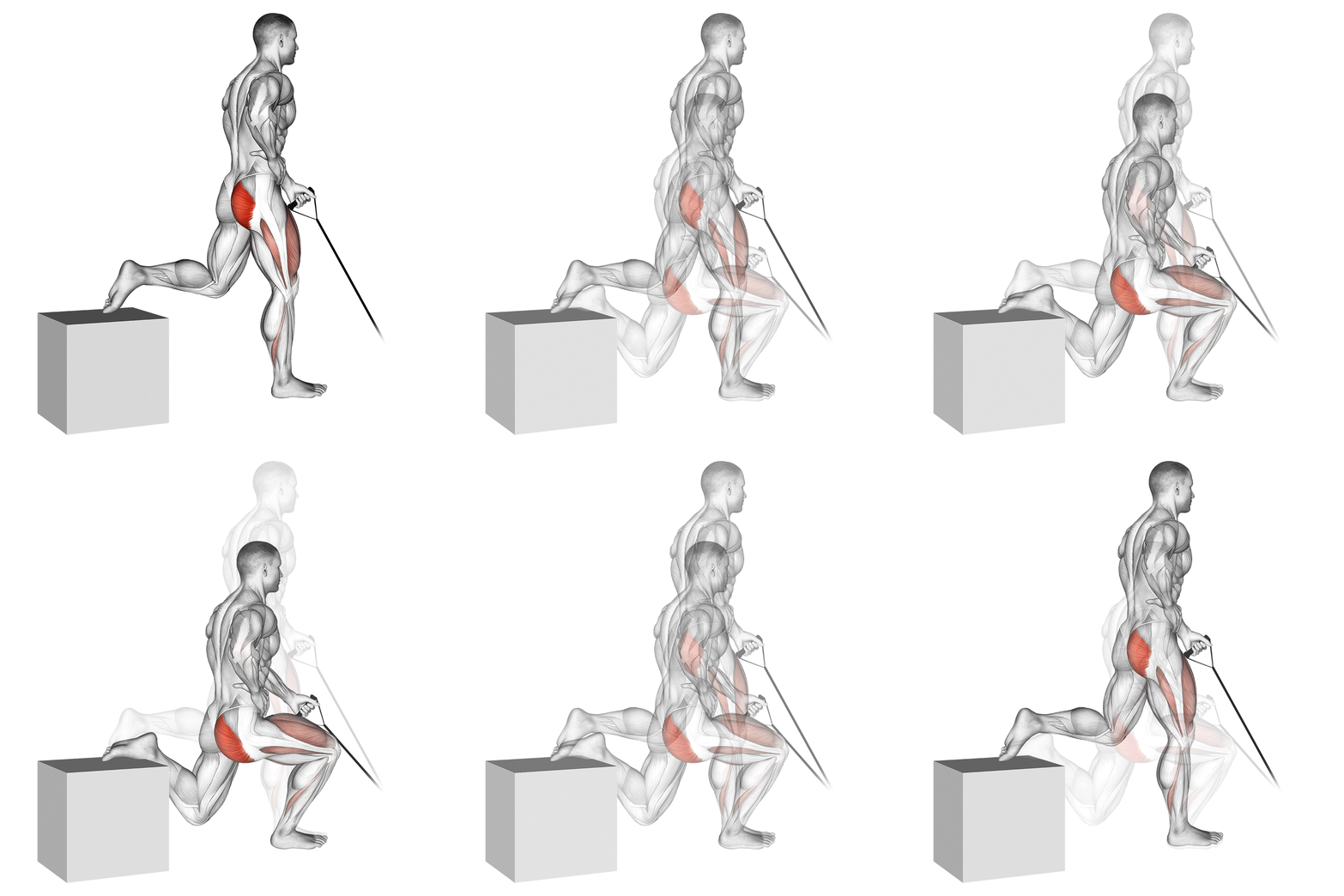
How to do the Band One Arm Single Leg Split Squat
- 1
Stand with your feet hip-width apart and place a resistance band around your ankles.
- 2
Extend one leg forward and rest the top of your foot on a bench or step behind you.
- 3
Hold onto a support with one hand for balance.
- 4
Bend your standing leg and lower your body down into a squat position, keeping your knee in line with your toes.
- 5
Push through your heel to return to the starting position.
- 6
Repeat for the desired number of repetitions, then switch legs.
Band One Arm Single Leg Split Squat Muscles Worked
The primary muscle group worked during the Band One Arm Single Leg Split Squat is the quads. Secondary muscles including the glutes and hamstrings assist throughout the movement, contributing to stability and force production.
- Primary muscle
- Quads
- Secondary muscles
- Glutes, Hamstrings
- Body part
- Upper Legs
- Movement type
- Compound
- Equipment needed
- A resistance band.
Sets and reps for the Band One Arm Single Leg Split Squat
The Band One Arm Single Leg Split Squat is a compound lift: several joints and muscles work together, so it suits both heavy strength work and moderate rep ranges. Put it early in your workout while you are fresh.
| Goal | Sets | Reps | Rest |
|---|---|---|---|
| Strength | 3 to 5 | 3 to 6 per side | 2 to 3 min |
| Muscle growth | 3 to 4 | 6 to 12 per side | 90 sec to 2 min |
| Endurance | 2 to 3 | 12 to 20 per side | 30 to 60 sec |
- To progress, switch to a heavier band or step farther from the anchor so the band starts with more tension.
- Work one side at a time and start with your weaker side, so it sets the number of reps for both.
- For muscle growth, about 10 to 20 hard sets per muscle per week works for most people, counting every exercise that trains the quads.
Band One Arm Single Leg Split Squat Alternatives
These exercises also train the quads, each with different equipment, so you can swap one in when your gym is busy, you train at home or you want a change.
- Split SquatsBody WeightNo band? This version needs no equipment, so you can do it at home or while traveling.
- Dumbbell Single Leg Split SquatDumbbellNo band? Dumbbells train each side on its own, which helps even out strength differences.
- Lever Leg ExtensionLeverage MachineNo band? The machine guides the path, so you can push hard safely without a spotter.
- Barbell Single Leg Split SquatBarbellNo band? A barbell lets you load the most weight and add it in small steps, which suits strength work.
- Smith Single Leg Split SquatSmith MachineNo band? The fixed bar path lets you train heavy without a spotter.
- Weighted Sissy SquatWeightedNo band? Adding a plate, vest or belt keeps it challenging once bodyweight reps get easy.
Exercises That Pair Well With the Band One Arm Single Leg Split Squat
For a short lower body workout, do the Band One Arm Single Leg Split Squat first while you are fresh, then 2 to 3 sets of each of these.
More Quads Exercises
- Band Single Leg Split Squat · Band
- Barbell Bench Front Squat · Barbell
- Barbell Bench Squat · Barbell
- Barbell Clean And Press · Barbell
- Barbell One Leg Squat · Barbell
- Barbell Overhead Squat · Barbell
Track the Band One Arm Single Leg Split Squat in YourFit
- Log sets, reps and weight in a few taps, with your previous sets for the Band One Arm Single Leg Split Squat shown next to each one.
- New personal records are flagged automatically, so you know when you beat your best.
- See your strength level, plus how many weekly sets each muscle gets, including the quads.