


Weighted Seated Twist (On Stability Ball)
What is the Weighted Seated Twist (On Stability Ball)?
The Weighted Seated Twist (On Stability Ball) is a core exercise that targets the abs, with help from the obliques and lower back, done using added weight such as a plate, vest or belt.
The weighted seated twist on a stability ball is an exercise that targets the abdominal muscles, particularly the obliques, while also engaging the lower back. It requires core strength, balance, and coordination due to the instability of the ball and the added resistance from the weight.
How to do the Weighted Seated Twist (On Stability Ball)
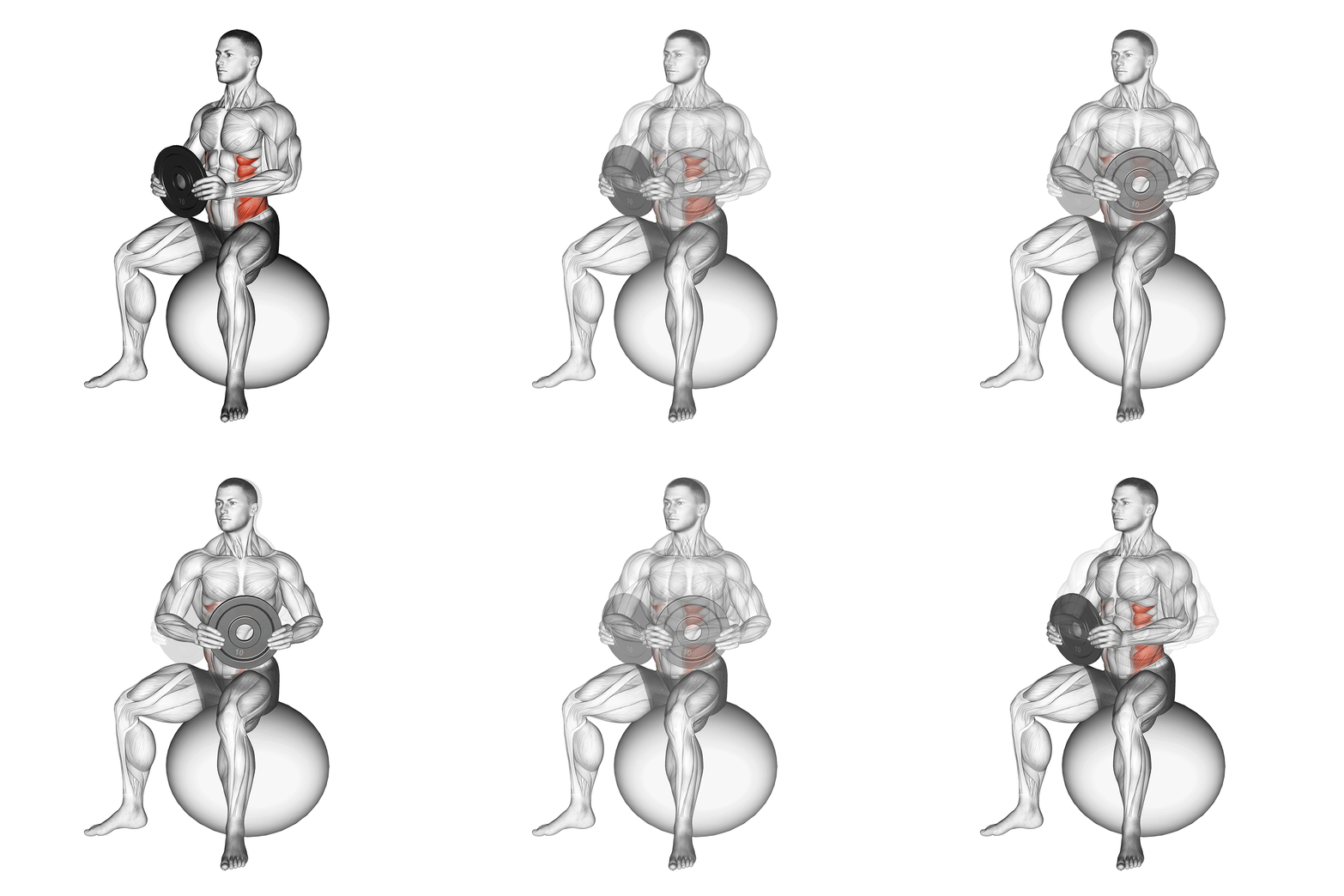
- 1
Sit on a stability ball with your feet flat on the ground and your knees bent at a 90-degree angle.
- 2
Hold a weight plate or dumbbell with both hands close to your chest.
- 3
Engage your core and slowly rotate your torso to one side, keeping your hips stable.
- 4
Pause for a moment at the end of the rotation, then slowly return to the starting position.
- 5
Repeat the rotation to the other side.
- 6
Continue alternating sides for the desired number of repetitions.
Weighted Seated Twist (On Stability Ball) Muscles Worked
The primary muscle group worked during the Weighted Seated Twist (On Stability Ball) is the abs. Secondary muscles including the obliques and lower back assist throughout the movement, contributing to stability and force production.
- Primary muscle
- Abs
- Secondary muscles
- Obliques, Lower Back
- Body part
- Waist
- Movement type
- Core
- Equipment needed
- Added weight such as a plate, vest or belt.
Sets and reps for the Weighted Seated Twist (On Stability Ball)
The Weighted Seated Twist (On Stability Ball) trains your core. Controlled reps with short rests work best, and you can do it at the end of most workouts or on its own on rest days.
| Goal | Sets | Reps | Rest |
|---|---|---|---|
| Strength | 3 to 4 | 8 to 12 (add load) | 60 to 90 sec |
| Muscle growth | 3 | 10 to 15 | 60 sec |
| Endurance | 2 to 3 | 15 to 25 | 30 to 45 sec |
- Add load in small steps (a 2.5 kg plate or a few kilograms on the vest or belt) once you reach the top of the rep range on every set.
- Keep your lower back under control and breathe out as you curl or brace; stop the set when you start pulling with your neck or hip flexors.
Weighted Seated Twist (On Stability Ball) Alternatives
These exercises also train the abs, each with different equipment, so you can swap one in when your gym is busy, you train at home or you want a change.
- Russian TwistBody WeightThis version needs no equipment, so you can do it at home or while traveling.
- Dumbbell Side BendDumbbellDumbbells train each side on its own, which helps even out strength differences.
- Lever Seated CrunchLeverage MachineThe machine guides the path, so you can push hard safely without a spotter.
- Cable TwistCableThe cable keeps tension on the abs through the whole range of motion.
- Barbell Seated TwistBarbellA barbell lets you load the most weight and add it in small steps, which suits strength work.
- Band Seated TwistBandA band is light and portable, good for home workouts, travel or warm-up sets.
Exercises That Pair Well With the Weighted Seated Twist (On Stability Ball)
For a short core workout, pair the Weighted Seated Twist (On Stability Ball) with 2 to 3 sets of each of these, resting about a minute between sets.
More Abs Exercises
- Weighted Side Bend (On Stability Ball) · Weighted
- Wheel Rollout · Wheel Roller
- Wind Sprints · Body Weight
- 3/4 Sit-Up · Body Weight
- 45° Side Bend · Body Weight
- Air Bike · Body Weight
Track the Weighted Seated Twist (On Stability Ball) in YourFit
- Log sets, reps and weight in a few taps, with your previous sets for the Weighted Seated Twist (On Stability Ball) shown next to each one.
- New personal records are flagged automatically, so you know when you beat your best.
- See your strength level, plus how many weekly sets each muscle gets, including the abs.