


Push-Up (Wall) (Variation 2)
This is a variation of the Push-Up (Wall). See that page for the standard version, alternatives and programming.
What is the Push-Up (Wall) (Variation 2)?
The Push-Up (Wall) is a compound strength exercise that targets the chest (pectorals), with help from the triceps and shoulders, done using only your body weight.
The wall push-up is a beginner-friendly variation of the traditional push-up, performed standing and pressing against a wall. It primarily targets the pectorals, with secondary emphasis on the triceps and shoulders. This exercise is ideal for those new to strength training or individuals seeking a low-impact alternative to floor push-ups.
How to do the Push-Up (Wall) (Variation 2)
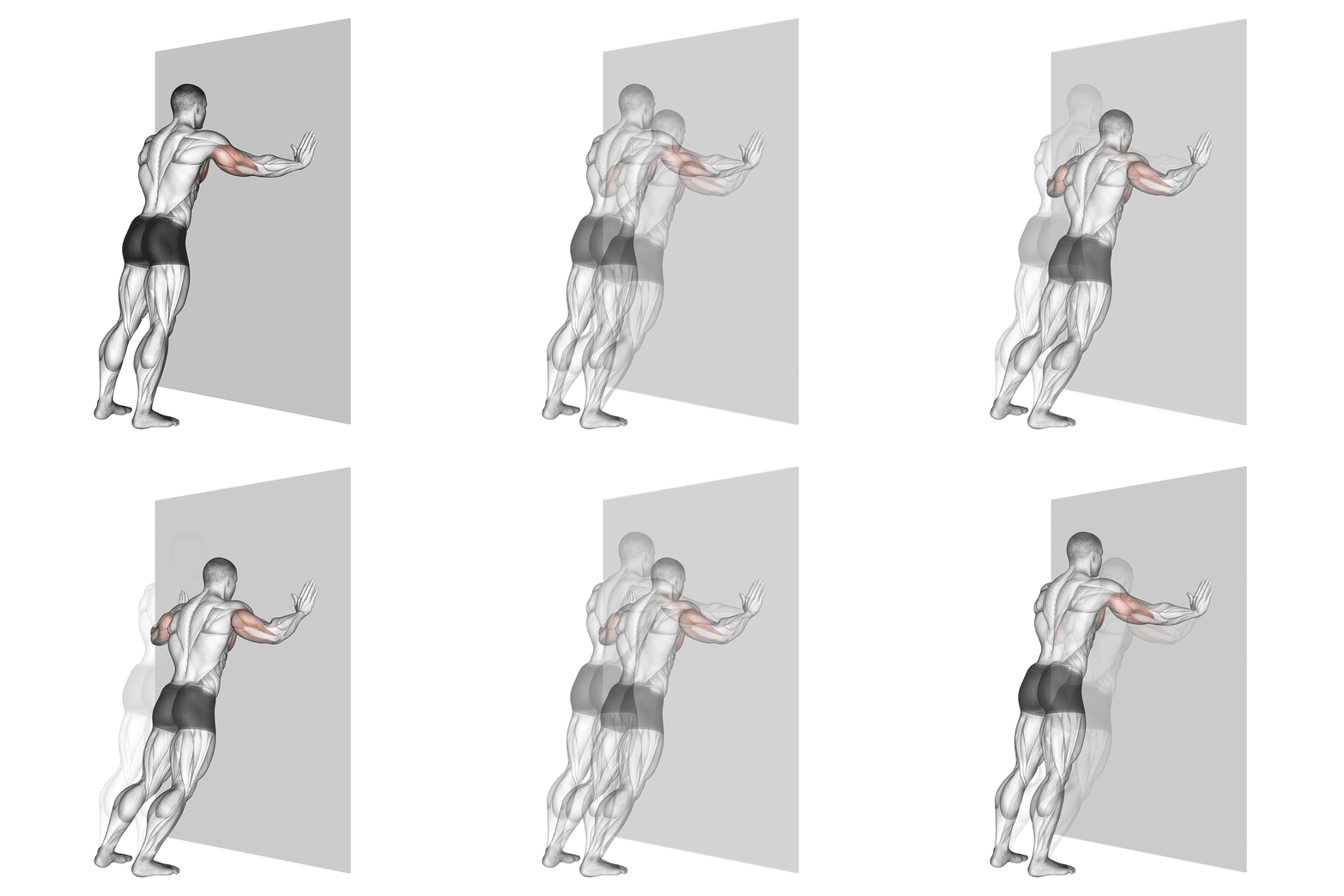
- 1
Stand facing a wall, about arm's length away.
- 2
Place your hands on the wall at shoulder height, slightly wider than shoulder-width apart.
- 3
Step back with your feet, keeping them hip-width apart.
- 4
Engage your core and keep your body in a straight line from head to heels.
- 5
Bend your elbows and lower your chest towards the wall, keeping your body straight.
- 6
Pause for a moment, then push yourself back to the starting position.
- 7
Repeat for the desired number of repetitions.
Push-Up (Wall) (Variation 2) Muscles Worked
The primary muscle group worked during the Push-Up (Wall) (Variation 2) is the chest (pectorals). Secondary muscles including the triceps and shoulders assist throughout the movement, contributing to stability and force production.
- Primary muscle
- Chest (Pectorals)
- Secondary muscles
- Triceps, Shoulders
- Body part
- Chest
- Movement type
- Compound
- Equipment needed
- No equipment needed: just your body weight.
Sets and reps for the Push-Up (Wall) (Variation 2)
The Push-Up (Wall) is a compound bodyweight exercise: several joints and muscles work together, so you progress by adding reps, slowing the tempo or moving to a harder version rather than adding plates.
| Goal | Sets | Reps | Rest |
|---|---|---|---|
| Strength | 3 to 5 | 3 to 8 (add weight or use a harder version) | 2 to 3 min |
| Muscle growth | 3 to 4 | 8 to 15 | 60 to 90 sec |
| Endurance | 2 to 3 | 15+, or as many clean reps as you can | 30 to 60 sec |
- To progress, add reps first, then slow the lowering phase to about 3 seconds, pause at the hardest point, or move to a harder variation.
- For muscle growth, about 10 to 20 hard sets per muscle per week works for most people, counting every exercise that trains the chest.
- New to the Push-Up (Wall)? Start with 2 to 3 sets, ending each set 2 or 3 reps before your form breaks down, and add a rep or two each week.
Push-Up (Wall) (Variation 2) Alternatives
These exercises also train the chest, each with different equipment, so you can swap one in when your gym is busy, you train at home or you want a change.
- Dumbbell Bench PressDumbbellWant more resistance? Dumbbells train each side on its own, which helps even out strength differences.
- Band Bench PressBandA band is light and portable, good for home workouts, travel or warm-up sets.
- Weighted Svend PressWeightedWant more resistance? Adding a plate, vest or belt keeps it challenging once bodyweight reps get easy.
- Cable Cross-Over VariationCableWant more resistance? The cable keeps tension on the chest through the whole range of motion.
- Lever Chest PressLeverage MachineWant more resistance? The machine guides the path, so you can push hard safely without a spotter.
Exercises That Pair Well With the Push-Up (Wall) (Variation 2)
For a short push workout, do the Push-Up (Wall) first while you are fresh, then 2 to 3 sets of each of these.
More Chest Exercises
- Push-Up Medicine Ball · Medicine Ball
- Push-Up Plus · Body Weight
- Raise Single Arm Push-Up · Body Weight
- Resistance Band Seated Chest Press · Resistance Band
- Shoulder Tap Push-Up · Body Weight
- Single Arm Push-Up · Body Weight
Track the Push-Up (Wall) (Variation 2) in YourFit
- Log sets, reps and weight in a few taps, with your previous sets for the Push-Up (Wall) (Variation 2) shown next to each one.
- New personal records are flagged automatically, so you know when you beat your best.
- See your strength level, plus how many weekly sets each muscle gets, including the chest.