


Dumbbell Step-Up
What is the Dumbbell Step-Up?
The Dumbbell Step-Up is a compound strength exercise that targets the glutes, with help from the quadriceps, hamstrings and calves, done using dumbbells.
The dumbbell step-up is a lower body exercise that targets the glutes, quadriceps, and hamstrings, while also engaging the calves. It involves stepping onto a raised platform while holding dumbbells, which increases resistance and challenges balance and coordination.
How to do the Dumbbell Step-Up
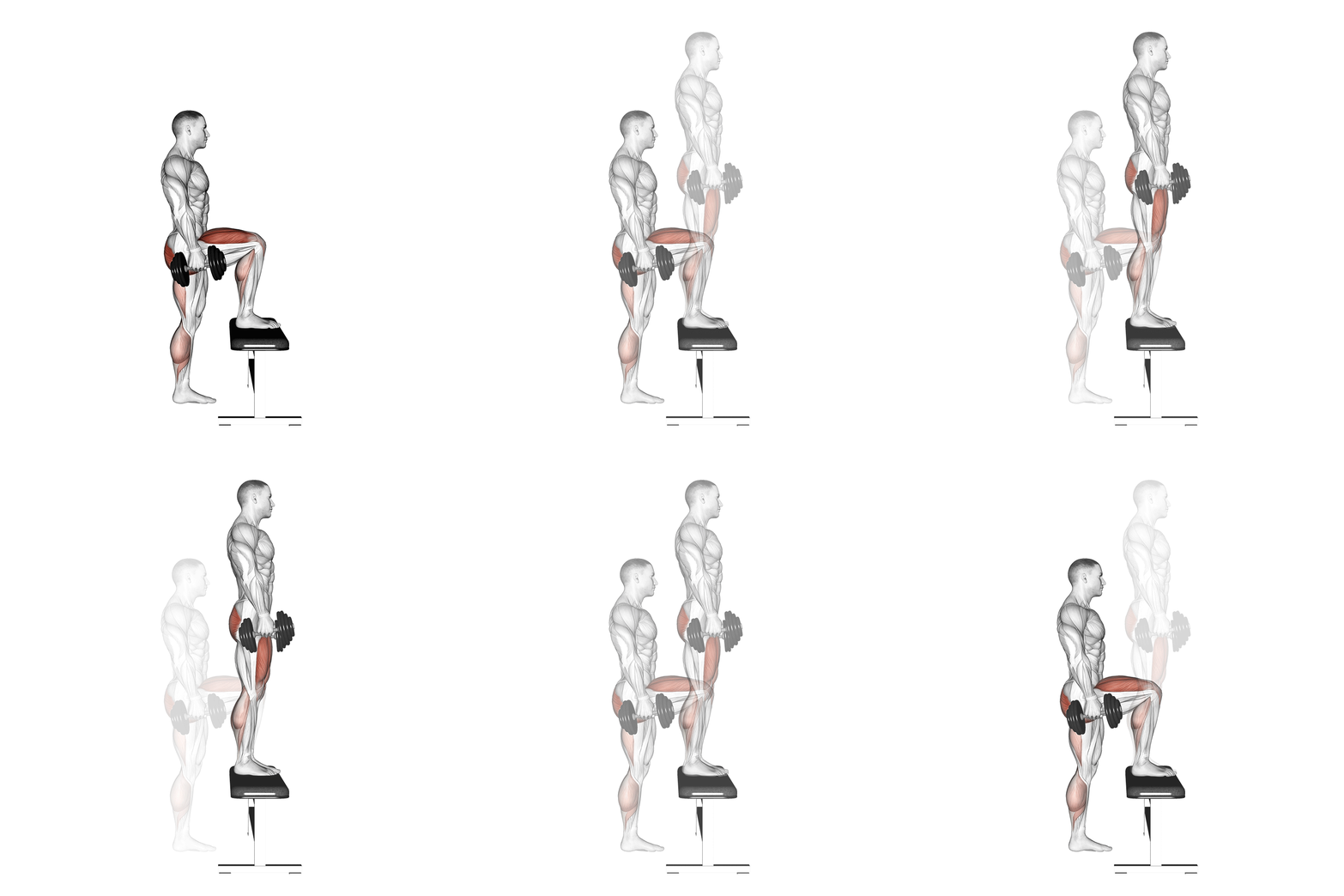
- 1
Stand in front of a bench or step with a dumbbell in each hand, palms facing your body.
- 2
Place your right foot on the bench or step, ensuring your entire foot is in contact with the surface.
- 3
Push through your right heel and lift your body up onto the bench or step, straightening your right leg.
- 4
Bring your left foot up onto the bench or step, standing fully upright.
- 5
Step back down with your left foot, followed by your right foot, returning to the starting position.
- 6
Repeat for the desired number of repetitions, then switch legs.
Dumbbell Step-Up Muscles Worked
The primary muscle group worked during the Dumbbell Step-Up is the glutes. Secondary muscles including the quadriceps, hamstrings and calves assist throughout the movement, contributing to stability and force production.
- Primary muscle
- Glutes
- Secondary muscles
- Quadriceps, Hamstrings, Calves
- Body part
- Upper Legs
- Movement type
- Compound
- Equipment needed
- Dumbbells, plus a sturdy box or step.
Sets and reps for the Dumbbell Step-Up
The Dumbbell Step-Up is a compound lift: several joints and muscles work together, so it suits both heavy strength work and moderate rep ranges. Put it early in your workout while you are fresh.
| Goal | Sets | Reps | Rest |
|---|---|---|---|
| Strength | 3 to 5 | 3 to 6 per side | 2 to 3 min |
| Muscle growth | 3 to 4 | 6 to 12 per side | 90 sec to 2 min |
| Endurance | 2 to 3 | 12 to 20 per side | 30 to 60 sec |
- Progress with double progression: once you reach the top of the rep range on every set, move to the next dumbbell (usually 1 to 2.5 kg or 2.5 to 5 lb heavier) and work back up.
- Work one side at a time and start with your weaker side, so it sets the number of reps for both.
- For muscle growth, about 10 to 20 hard sets per muscle per week works for most people, counting every exercise that trains the glutes.
Dumbbell Step-Up Alternatives
These exercises also train the glutes, each with different equipment, so you can swap one in when your gym is busy, you train at home or you want a change.
- Barbell Step-UpBarbellNo dumbbells? A barbell lets you load the most weight and add it in small steps, which suits strength work.
- Cable DeadliftCableNo dumbbells? The cable keeps tension on the glutes through the whole range of motion.
- Sled Hack SquatSled MachineNo dumbbells? The machine guides the path, so you can push hard safely without a spotter.
- Walking LungeBody WeightNo dumbbells? This version needs no equipment, so you can do it at home or while traveling.
- Kettlebell SwingKettlebellNo dumbbells? The kettlebell's offset weight adds a grip and stability challenge.
- Band Step-UpBandNo dumbbells? A band is light and portable, good for home workouts, travel or warm-up sets.
Exercises That Pair Well With the Dumbbell Step-Up
For a short lower body workout, do the Dumbbell Step-Up first while you are fresh, then 2 to 3 sets of each of these.
More Glutes Exercises
- Dumbbell Stiff Leg Deadlift · Dumbbell
- Dumbbell Straight Leg Deadlift · Dumbbell
- Dumbbell Sumo Pull Through · Dumbbell
- Exercise Ball Hip Flexor Stretch · Stability Ball
- Flutter Kicks · Body Weight
- Forward Lunge · Body Weight
Track the Dumbbell Step-Up in YourFit
- Log sets, reps and weight in a few taps, with your previous sets for the Dumbbell Step-Up shown next to each one.
- New personal records are flagged automatically, so you know when you beat your best.
- See your strength level, plus how many weekly sets each muscle gets, including the glutes.