


Cable Seated High Row (V-Bar)
What is the Cable Seated High Row (V-Bar)?
The Cable Seated High Row (V-Bar) is a compound strength exercise that targets the lats, with help from the biceps, rhomboids and rear deltoids, done using a cable machine.
The cable seated high row (v-bar) is a compound exercise targeting the latissimus dorsi, performed on a cable machine using a v-bar attachment. It also engages the biceps, rhomboids, and rear deltoids, making it effective for developing upper back strength and muscle definition.
How to do the Cable Seated High Row (V-Bar)
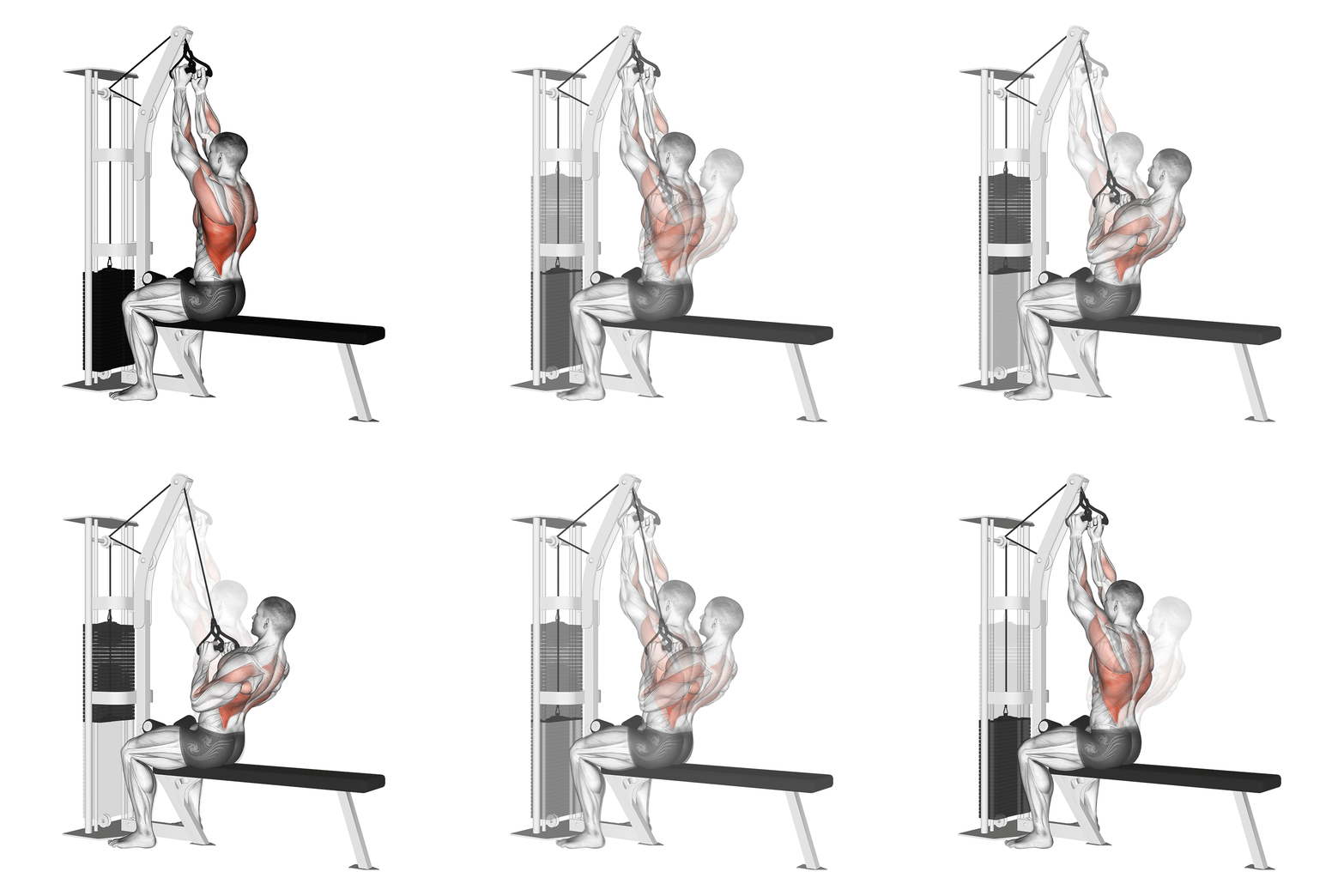
- 1
Sit on the cable machine with your feet flat on the floor and your knees slightly bent.
- 2
Grasp the v-bar attachment with an overhand grip, palms facing each other, and your hands shoulder-width apart.
- 3
Keep your back straight and lean slightly forward from the hips.
- 4
Pull the v-bar towards your torso by retracting your shoulder blades and squeezing your back muscles.
- 5
Pause for a moment at the peak of the contraction, then slowly release the tension and return to the starting position.
- 6
Repeat for the desired number of repetitions.
Cable Seated High Row (V-Bar) Muscles Worked
The primary muscle group worked during the Cable Seated High Row (V-Bar) is the lats. Secondary muscles including the biceps, rhomboids and rear deltoids assist throughout the movement, contributing to stability and force production.
- Primary muscle
- Lats
- Secondary muscles
- Biceps, Rhomboids, Rear Deltoids
- Body part
- Back
- Movement type
- Compound
- Equipment needed
- A cable machine, plus a V-bar attachment.
Sets and reps for the Cable Seated High Row (V-Bar)
The Cable Seated High Row (V-Bar) is a compound lift: several joints and muscles work together, so it suits both heavy strength work and moderate rep ranges. Put it early in your workout while you are fresh.
| Goal | Sets | Reps | Rest |
|---|---|---|---|
| Strength | 3 to 5 | 3 to 6 | 2 to 3 min |
| Muscle growth | 3 to 4 | 6 to 12 | 90 sec to 2 min |
| Endurance | 2 to 3 | 12 to 20 | 30 to 60 sec |
- Progress with double progression: once you reach the top of the rep range on every set, move the pin one plate heavier and work back up.
- For muscle growth, about 10 to 20 hard sets per muscle per week works for most people, counting every exercise that trains the lats.
- New to the Cable Seated High Row (V-Bar)? Spend the first 2 to 3 weeks in the muscle growth range with a load you could lift 2 or 3 more times, then try heavier sets.
Cable Seated High Row (V-Bar) Alternatives
These exercises also train the lats, each with different equipment, so you can swap one in when your gym is busy, you train at home or you want a change.
- Assisted Pull-UpLeverage MachineNot there yet? The assistance takes part of your body weight off, so you can build up to the full movement.
- Band Assisted Pull-UpBandNot there yet? The assistance takes part of your body weight off, so you can build up to the full movement.
- Barbell PulloverBarbellNo cable station? A barbell lets you load the most weight and add it in small steps, which suits strength work.
- Pull-UpBody WeightNo cable station? This version needs no equipment, so you can do it at home or while traveling.
- Weighted Pull-UpWeightedNo cable station? Adding a plate, vest or belt keeps it challenging once bodyweight reps get easy.
Exercises That Pair Well With the Cable Seated High Row (V-Bar)
For a short pull workout, do the Cable Seated High Row (V-Bar) first while you are fresh, then 2 to 3 sets of each of these.
More Lats Exercises
- Cable Squat Row (With Rope Attachment) · Cable
- Cable Straight Arm Pulldown · Cable
- Cable Thibaudeau Kayak Row · Cable
- Cable Twisting Pull · Cable
- Cable Underhand Pulldown · Cable
- Cable Wide Grip Rear Pulldown Behind Neck · Cable
Track the Cable Seated High Row (V-Bar) in YourFit
- Log sets, reps and weight in a few taps, with your previous sets for the Cable Seated High Row (V-Bar) shown next to each one.
- New personal records are flagged automatically, so you know when you beat your best.
- See your strength level, plus how many weekly sets each muscle gets, including the lats.